
On a busy Friday night in February, your server drops a ticket and the kitchen printer goes silent. Outside it is minus ten. Your POS vendor's support line is on Eastern time and closed. That single scenario explains why the choice of a restaurant POS system matters more in Alaska than it does in most places, and why the details—support hours, spare hardware, network reliability—deserve as much attention as the monthly software fee.
What a Restaurant POS System Actually Does
A restaurant POS system is the software and hardware that takes an order, routes it to the kitchen or bar, tracks what was sold, and closes the payment. On a real counter that means a touchscreen station, a cash drawer, a receipt printer, and a pin pad for cards. In a full-service room it usually adds handheld devices for tableside ordering and a kitchen display or printer in the back.
Beyond the transaction itself, a modern system handles split checks, modifiers, voids, comps, and end-of-day reporting. It tracks inventory if you want it to. It feeds payroll hours if you use that module. It keeps a record of every sale so you can see which menu items are carrying the week and which are not.
None of that is complicated in concept. What varies is how well it holds up when the internet hiccups, when a device fails, and when you need a human being to answer the phone.
What Makes Alaska Different for POS
Freight is the first thing. Hardware that ships from the Lower 48 takes time and costs more to get here. If a station fails in Juneau or Bethel, waiting a week for a replacement is not an abstract inconvenience—it is a week of handwritten tickets or a closed bar tab.
The second thing is time zone. Alaska Standard Time is four hours behind the East Coast. A support line that closes at 8 p.m. Eastern closes at 4 p.m. here. That covers your lunch rush and nothing else.
The third is seasonality. A lodge on the Kenai that runs May through September should not pay twelve months of software fees. A cannery café that closes for the winter freeze should have a way to pause, not cancel and restart.
The fourth is connectivity. Many Alaska communities have limited or variable internet. A POS system that cannot process a card offline, or whose network nobody is watching, is a liability in a place where calling your ISP can mean a two-day wait.
How to Evaluate a POS System for Your Restaurant
When you are comparing options, these are the practical questions worth asking:
- Where is support, and what hours? A local company in your time zone answers differently than a national call center.
- What happens when a device fails? Ask specifically whether spare hardware is stocked nearby and how fast a swap happens.
- Is there a term contract? Some systems lock you in for one to three years with an early-termination fee. Others are month to month.
- How is hardware priced? Some national brands bundle hardware costs into a higher processing rate, which means you pay for the equipment through every card swipe for years. Published upfront prices let you compare honestly.
- What does the network look like? A managed network—one that someone monitors and can troubleshoot remotely—is worth asking about, especially in Alaska.
- Can you pause for a closed season? If your business is seasonal, find out before you sign.
National brands like Toast, Clover, and Square each have large user bases and real software capabilities. They are worth evaluating. The honest trade-off is that their support is typically remote and on mainland time, hardware costs are sometimes embedded in processing rates rather than listed plainly, and a technician flying to your location is not part of their model.
What the Best POS System for a Restaurant Looks Like in Practice
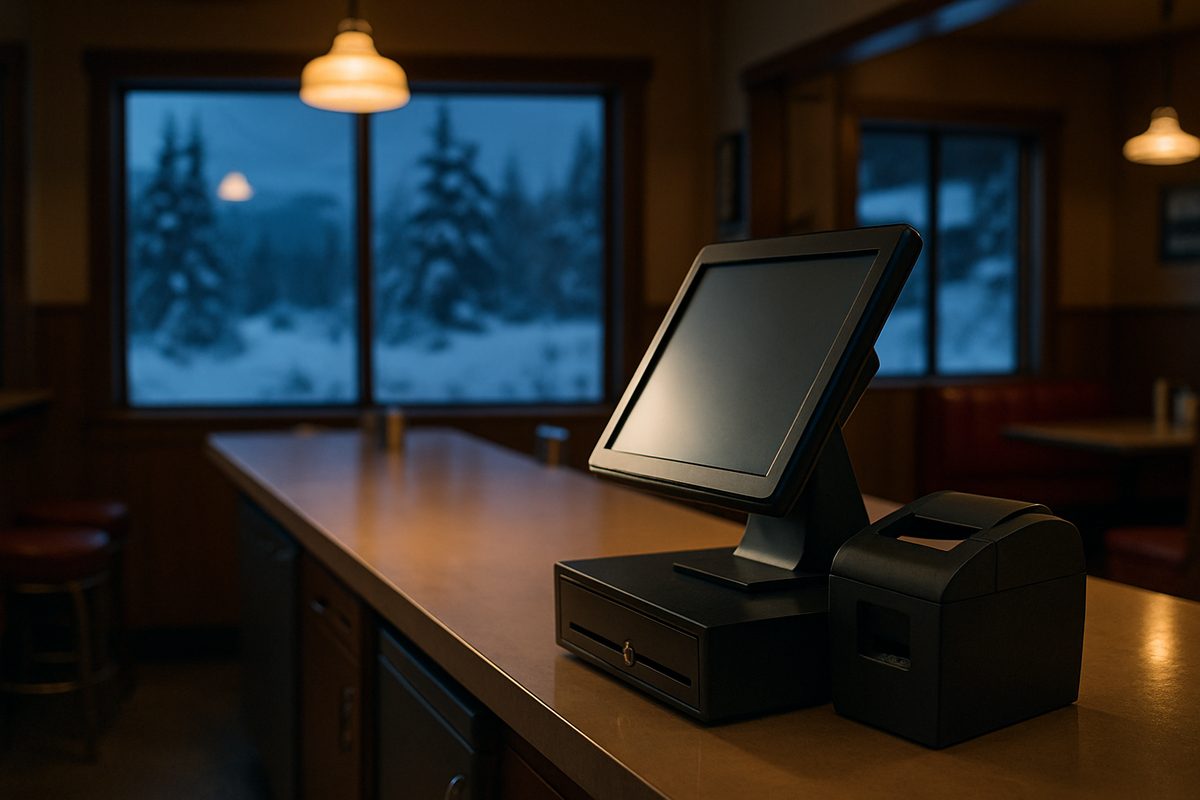
The best pos system for a restaurant is the one that runs quietly on a normal night and gets fixed fast on a bad one. Here is what a typical Alyeska POS install looks like on a counter in Alaska.
We arrive, mount the station, run the cables, connect the kitchen printer, and configure the menu before we leave. Training is included. The network is managed—we can see it remotely and respond before you notice a problem in most cases. If a device fails, the hardware care plan covers every device in the kit for $15 a month per location, and we send a replacement before you ship the broken unit back.
Software runs month to month. No contract, no early-termination fee. If your restaurant closes for winter, the Winter Freeze feature pauses your software billing for those months. When you reopen, you pick up where you left off.
Hardware is priced plainly:
| Kit | Price | Typical use |
|---|---|---|
| Countertop kit | $1,800 | Quick service, café, food truck |
| Handheld kit | $1,000 | Tableside ordering, add-on to countertop |
| Bar & Nightlife kit | $2,600 | Bar, brewery, nightclub |
| Retail kit | $2,300 | Gift shop, general store, bottle shop |
Software is $99, $199, or $299 a month per location depending on the tier. Processing is interchange plus 0.30% plus 10 cents per transaction, or a cash-discount program that shows a 3.99% service fee on the receipt and cuts hardware cost by 50%. Spares are kept in Anchorage. Support answers in Alaska time.
One Thing to Check Before You Decide
Alaska has its own rules around cash-discount programs and surcharging. The card brands also have their own requirements. Before you choose a pricing model for how you pass processing costs to customers, check with the card brands' published guidelines and your accountant. We can explain how our programs work; the compliance question is yours to confirm.
If you want to see exactly what each tier includes and run the numbers for your location, the pricing page at alyeskapos.com/pricing lays it out, or call us at (907) 290-8555 and we will walk through it with you.
Want a straight answer for your counter?
Prices are on the page, and a person in Anchorage answers the phone. (907) 290-8555.
See pricing Request a call